



As electric mobility (e-mobility) becomes more widespread across Asia and the Pacific, countries are increasingly exploring climate finance as a way to accelerate investment, especially where upfront costs remain high. Presentations at the Regional Meeting and Workshop on Unlocking Finance for Scaling Up Electric Mobility in Asia and the Pacific on 4 December 2025 highlighted an important reality: climate finance opportunities exist, but they are evolving quickly, and projects need to be structured strategically to meet eligibility requirements and demonstrate strong climate additionality.
Jurg Grutter from Grutter Consulting discussed the principles of financing provided by the world’s largest climate financier, the Green Climate Fund (GCF). The GCF provides, in particular, concessional loans for investments and grants for technical assistance. However, for accessing these funds, projects must be innovative and go beyond “business-as-usual.” Electric mobility is a swiftly evolving field, where the technological advancements are quickly leading to higher performance of the vehicles, lower technology costs, and thus, also lowered financial risks. In today’s market, standalone urban electric bus procurement is increasingly viewed as a business-as-usual, low-risk investment, meaning it is less likely to qualify for GCF support unless it is part of a broader system transformation.
In this evolving landscape, GCF is more likely to support emerging or harder-to-finance segments, such as electric trucks, intercity buses, electric vessels, heavy-duty machinery, and initiatives like zero-emission zones that combine technology, infrastructure, policy, and behavior change. This pushes governments to think more holistically.
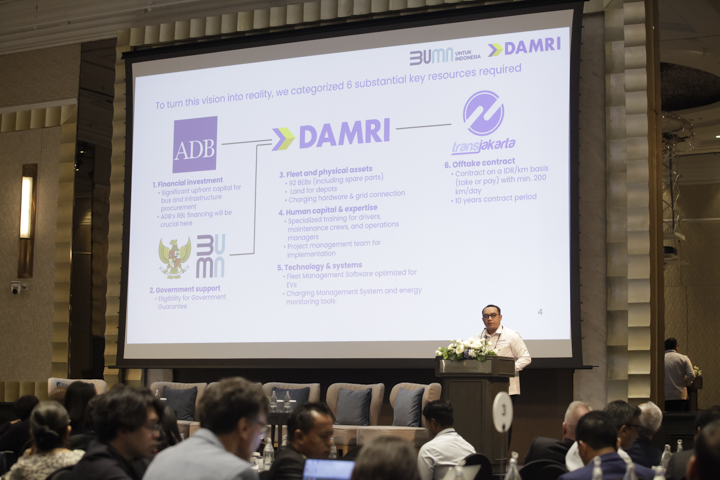
DAMRI’s Vice President of Corporate Strategy, Dipowirawan Kurnae presenting at the Regional Meeting and Workshop on Unlocking Finance for Scaling Up E-Mobility in Asia and the Pacific in Bangkok, Thailand from 1-4 December 2025.
Beyond GCF, carbon markets were discussed as a potential supplementary revenue stream. While voluntary markets have faced credibility challenges, compliance-driven markets and Article 6 mechanisms under the Paris Agreement are expanding. For some projects, carbon revenue may not be large enough to cover the full investment required, but it can provide meaningful results-based payments that strengthen overall financial viability.
A complementary perspective was offered by Olly Norojono, ADB consultant, through the example of ADB’s multi-country e-mobility program supported by GCF, the ADB-GCF E-Mobility Programme. This programmatic approach includes seven countries and was designed to reduce transaction costs and create broader impact compared to developing separate standalone proposals. Yet it also illustrates a practical lesson: the development timeline of such projects tends to be lengthy, and this needs to be prepared for.
The program also demonstrates that eligibility criteria matter. The ADB-GCF E-Mobility Programme proceeds are capped per country and per component. Co-financing is required, and projects need to include broader improvements to public transport systems – not only procurement of electric buses. Retrofitting of existing fleet is not eligible, and projects also need to comply with safeguards and gender action planning requirements.
A concrete implementation example was provided through Indonesia’s DAMRI, which is developing an electric bus project in Jakarta, as part of the ADB-GCF E-Mobility Programme. DAMRI’s Vice President of Corporate Strategy, Dipowirawan Kurnaen, shared that the project scope includes deploying 92 battery electric buses and reconstructing three depots with charging infrastructure to demonstrate technical and financial viability for future scale-up. This approach includes systemic elements, including fleet and charging management system optimization, climate resilience of depots, gender separated facilities for employees, as well as capacity building for drivers and other staff. DAMRI highlighted that moving from ambition to implementation required multiple steps for ensuring “bankability”, or investment-readiness; feasibility studies, safeguards compliance, robust procurement planning, financial structuring, risk mitigation, and strong stakeholder alignment.
In conclusion, the key lesson for governments and other project developers is clear: climate finance can be a powerful accelerator, but the window for straightforward e-bus funding is narrowing. To succeed, projects must be designed in alignment with policy reforms and system improvements, and structured to demonstrate long-term impact beyond replacing vehicles.
Download the presentations from this session.
