



Public-private partnerships (PPPs) are increasingly considered by governments seeking to modernize public transport systems and accelerate the shift to electric mobility. In his presentation at the Regional Meeting and Workshop on Unlocking Finance for Scaling Up Electric Mobility (E-mobility) in Asia and the Pacific, on 4 December 2025, Henri Devys of the Asian Development Bank’s Office for Market Development and Public-Private Partnerships (OMDP) described PPPs as long-term contracts between the public and private sector for constructing and/or operating infrastructure. When structured well, PPPs can mobilize private capital, strengthen performance incentives, and improve operational efficiency.
The key motivations for using PPPs in e-mobility are straightforward. First, the private sector can help bridge financing gaps, especially where infrastructure investment needs exceed public budgets. Second, PPPs can improve delivery performance by linking payment and incentives to on-time and on-budget implementation. And third, private operators may bring technical and operational expertise that improves service quality and long-term system performance.
However, as emphasized by Devys, PPPs are not a “one-size-fits-all” solution. They involve complex design choices, including what risks are transferred to the private partner and which responsibilities remain with government. This is particularly true for public transport systems which are particularly sensitive to affordability, service reliability, and public trust. The scope of a PPP may include only operations and maintenance, or it can expand to include rolling stock, depots, ticketing systems, charging infrastructure, terminals, or even retail and parking revenues.
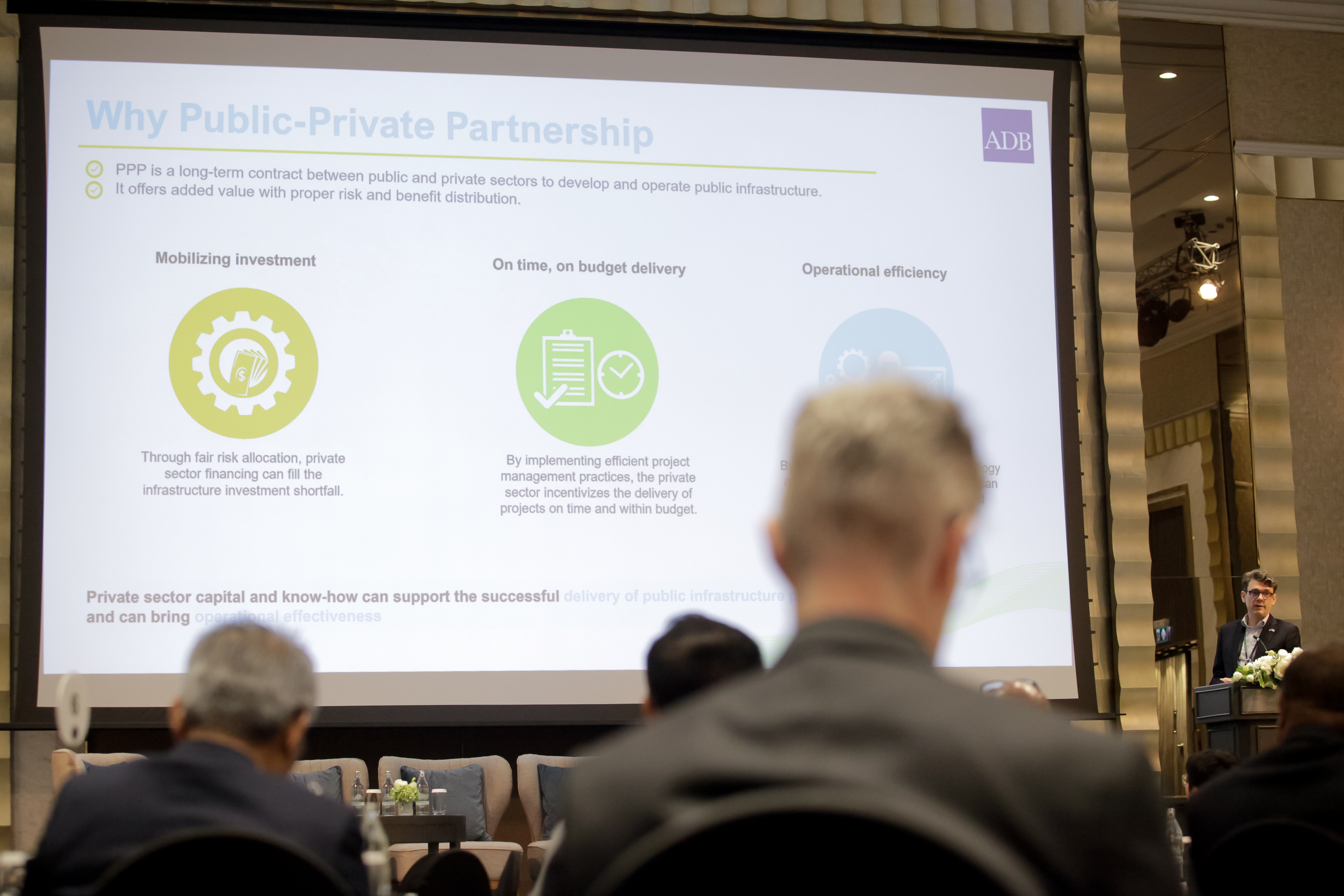
ADB's Henri Devys presenting during the Regional Meeting and Workshop on Unlocking Finance for Scaling Up E-Mobility in Asia and the Pacific in Bangkok, Thailand from 1-4 December 2025.
ADB’s OMDP supports governments across the project cycle, including enabling environment support, transaction advisory services, and contract monitoring. In practical terms, transaction advisory involves project conceptualization, feasibility analysis, market sounding, preparing tender documents and contracts, supporting bidding and evaluation, and assisting with contract award and financial close. ADB ensures that the project is bankable for the private sector, while offering the best value for money to the public sector. Importantly, this role by ADB can help ensure PPP processes are transparent and competitive, giving confidence to private investors and increasing the likelihood of strong bids.
A key case example shared was the Davao Public Transport Modernization Project in the Philippines, a citywide effort to replace a fragmented and informal transport network dominated by thousands of public utility jeepneys with a modern bus system. Davao’s challenges included unreliable service, complex routing, limited accessibility, and environmental impacts. The project aims to develop a new bus system supported by infrastructure upgrades and a major fleet deployment, including electric buses.
This case illustrates a common reality: even when a public infrastructure project is financed through government-led, sovereign loans, PPPs may still play a critical role in operations. The system planned for Davao is new and thus, demand uncertainty is high. Private operators are unwilling to take full passenger demand risk, so the government designed a model where it collects fares and pays operators through annuity-based payments.
The market sounding process also revealed that private firms are hesitant to take full risk for an all-electric fleet, particularly when they are not selecting the vehicles themselves. To balance risk and maintain competition, the project is structured around performance-based O&M contracts, mixed fleets, and multiple operators rather than relying on a single concessionaire. It is important to note, as well, that the project includes a social development program for affected stakeholders, such as jeepney operators and drivers, which includes both financial and non-financial support tools.
For governments considering PPPs in e-mobility, the key takeaway is that private participation can significantly strengthen project delivery – but only if risks, incentives, and responsibilities are carefully matched to market realities. A well-prepared PPP is not simply a procurement method: it is a tool for building long-term performance into the public transport system.
Download Henri Devys' presentation.
