



As economies in Asia and the Pacific accelerate their transition toward low-carbon transport, the private sector is emerging as a central driver of e-mobility deployment. This role of the private sector was explored as part of the Regional Meeting and Workshop on Unlocking Finance for Scaling Up E-Mobility in Asia and the Pacific, held in Bangkok, Thailand on 1-4 December 2025. The panel discussion ‘Private Sector Involvement in Financing E-Mobility’ convened private sector leaders with multilateral players, exploring how investment, innovation, and partnerships can unlock scalable and sustainable electric mobility across the region.
Panelists consistently emphasized that scaling e-mobility cannot rely on public finance alone. Private sector engagement is essential not only for mobilizing capital, but also for introducing innovation, operational expertise, and new business models across the market for electric vehicles, charging infrastructure, and related services. Experiences shared during the session demonstrated how private companies are already leading deployment, often moving faster than regulatory frameworks can adapt.
The international community and national governments play a central role in creating an enabling environment for private sector investment in e-mobility. Here are four key recommendations that came out of the discussion:
Risk management is key for unlocking investment
Despite strong interest among private companies, perceived risks continue to constrain private investment in e-mobility. Panelists highlighted several recurring challenges, including policy uncertainty, demand risk, and the fragmented nature of early-stage markets. These factors often deter commercial lenders and investors, particularly in developing member countries.
Blended finance and multilateral development bank (MDB) support were repeatedly cited as critical tools to address these barriers. ADB emphasized that by combining commercial capital with concessional finance, guarantees, and technical assistance, MDBs can help de-risk projects, reduce financing costs, and crowd in private investors especially in nascent markets where business models are still being proven.
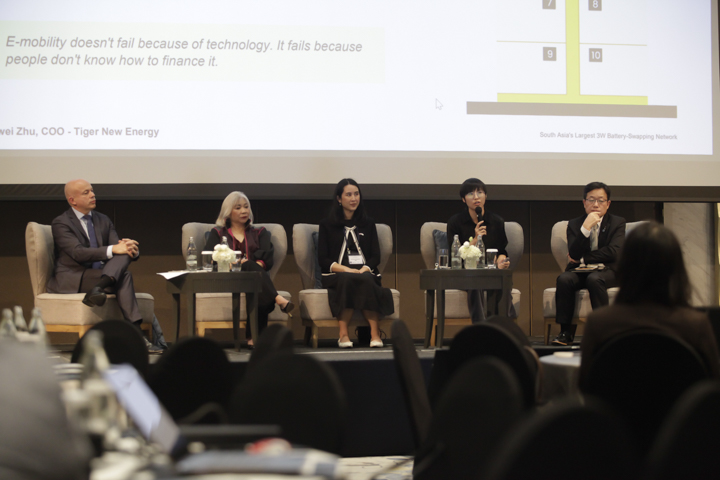
Panelists during the session on "Private Sector Involvement in Financing E-Mobility", held as part of the Regional Meeting and Workshop on Unlocking Finance for Scaling Up E-Mobility in Asia and the Pacific in Bangkok, Thailand from 1-4 December 2025.
Innovation around financing and business models can help reduce risk
Given the early-stage nature of many e-mobility markets, traditional financing structures and asset ownership models are not always suitable for private sector settings. Panelists noted that rigid approaches to project design, financing, and partnerships can amplify perceived risks related to demand uncertainty, technology evolution, and political or currency exposure. As a result, flexible and innovative approaches that align incentives across stakeholders, adapt to local market conditions, and share risks more effectively were seen as essential for scaling private sector participation.
Tiger New Energy, a battery swapping provider in Bangladesh, shared an example of a locally anchored financing model that brings together drivers, local partners, municipal authorities, pension funds, and development finance institutions. This approach reduced political and currency risks while improving economic feasibility, demonstrating that innovative e-mobility business models can thrive even in volatile contexts.
Further support is needed for packaging ideas into bankable projects
A major constraint identified across markets is the shortage of bankable, or investment-ready, project pipelines. While interest in e-mobility is growing, many projects struggle to reach financial close due to weak project preparation, unclear risk allocation, and the absence of standardized contractual frameworks.
Panelists stressed the importance of stronger project development support, including early-stage technical assistance, demand aggregation, and the use of standardized approaches for contracts and financing structures. These measures can help transform promising concepts into investable projects, enabling private capital to flow at scale.
Governments play a central role in creating enabling environments
Governments play a pivotal role in shaping the investment environment for e-mobility. Rather than crowding out private initiative, panelists argued that governments should focus on providing clear policy signals, streamlined permitting processes, and predictable regulatory frameworks. Early and continuous engagement with the private sector was highlighted as essential to ensure that regulations reflect on-the-ground realities and do not inadvertently stifle innovation. In the Philippines, the example by ACMobility Holdings Incorporated showed how private investment can accelerate market development through rapid build-out of charging infrastructure, when supported by enabling policies and concessional finance.
UNIDO underscored the need for regional collaboration on e.g. standards, interoperability, and regulatory harmonization, to avoid market fragmentation and unlock economies of scale for emerging technologies such as battery swapping.
The discussion concluded with a clear message: private sector participation is indispensable to achieving Asia and the Pacific’s e-mobility ambitions. Unlocking its full potential will require coordinated action, combining innovative financing, strong public-private collaboration, robust project preparation, and clear, forward-looking policies. With these elements in place, e-mobility can move faster from pilot projects to mainstream deployment, driving low-emission transport across the region.
Download the presentations from this session.
