


Wednesday, 28th May 2025
12:00-1:30pm Manila time (GMT +8)
Online/ Zoom
About this Workshop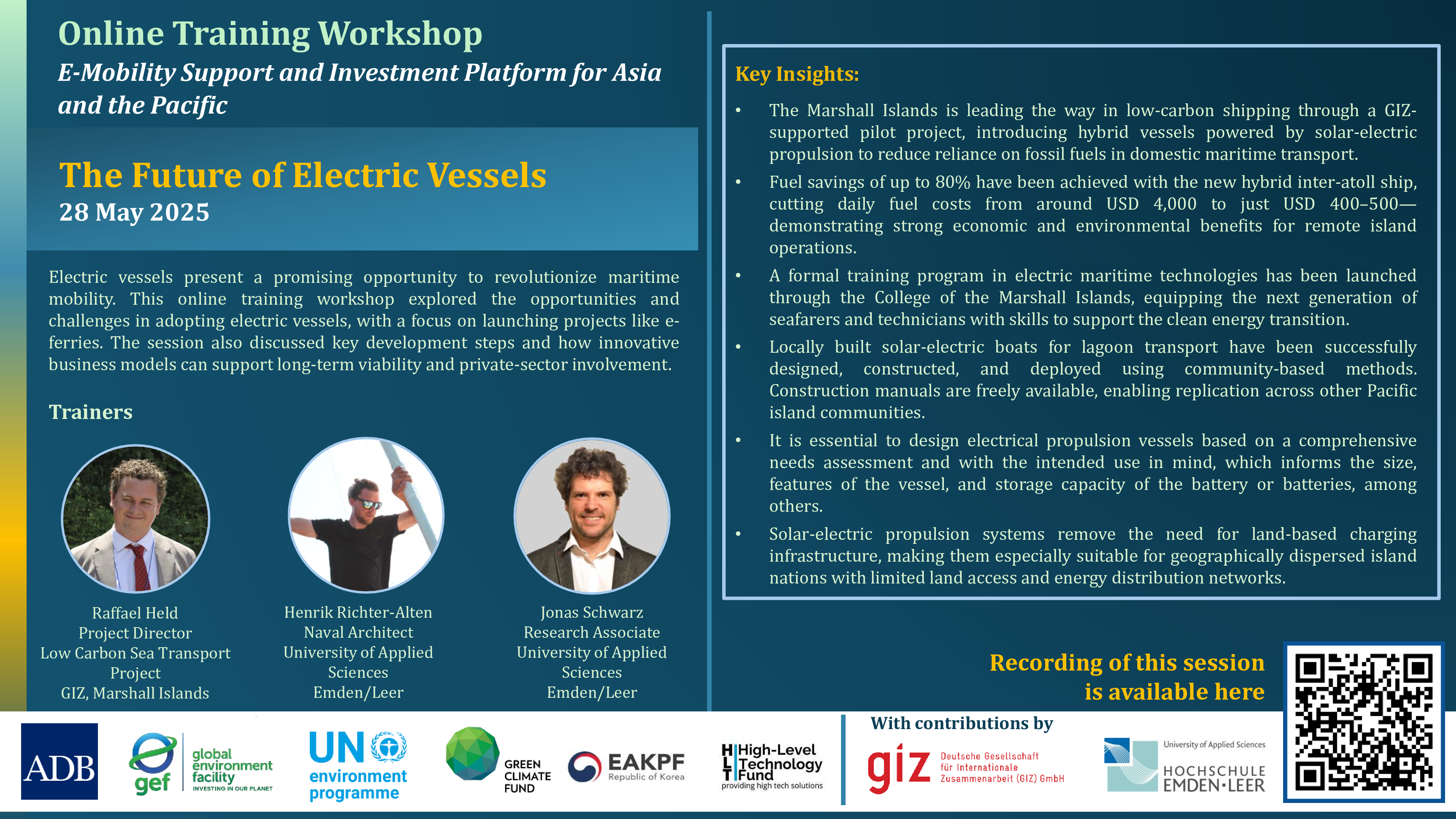
As the Pacific Island Countries explore sustainable transport solutions, electric ferries and other light vessels present a promising opportunity to revolutionize maritime mobility. However, adoption remains in its early stages with unique challenges and opportunities shaping the transition.
This training workshop provided insights into the business potential and feasibility of electric light vessels in the region. It shared lessons from the GIZ-led Low Carbon Sea Transport pilot project in Marshall Islands as an exemplary initiative.
About the Trainers
Raffael Held, Project Director of the Low Carbon Sea Transport Project, GIZ Marshall Islands, has a strong expertiese in marine operational engineering. He is dedicated to driving innovation in sustainable maritime transport for small island nations.
Henrik Richter-Alten, Naval Architect at the University of Applied Sciences Emden/Leer, specializes in wind and solar-electric propulsion systems, and has contributed to e-vessel projects in Marshall Islands and Uganda, among others.
Jonas Schwarz, Research Associate at the University of Applied Sciences Emden/Leer, has years of experience teaching engineering students, including on a solar-electric research vessel. His strengths are knowledge transfer and training.
Watch the full-length Workshop:
