


Walking and cycling represent the least carbon intensive modes of transport producing an average of 0g.CO2 /km and 8g.CO2 /km respectively and are notable for their wider public health and activity-related benefits.
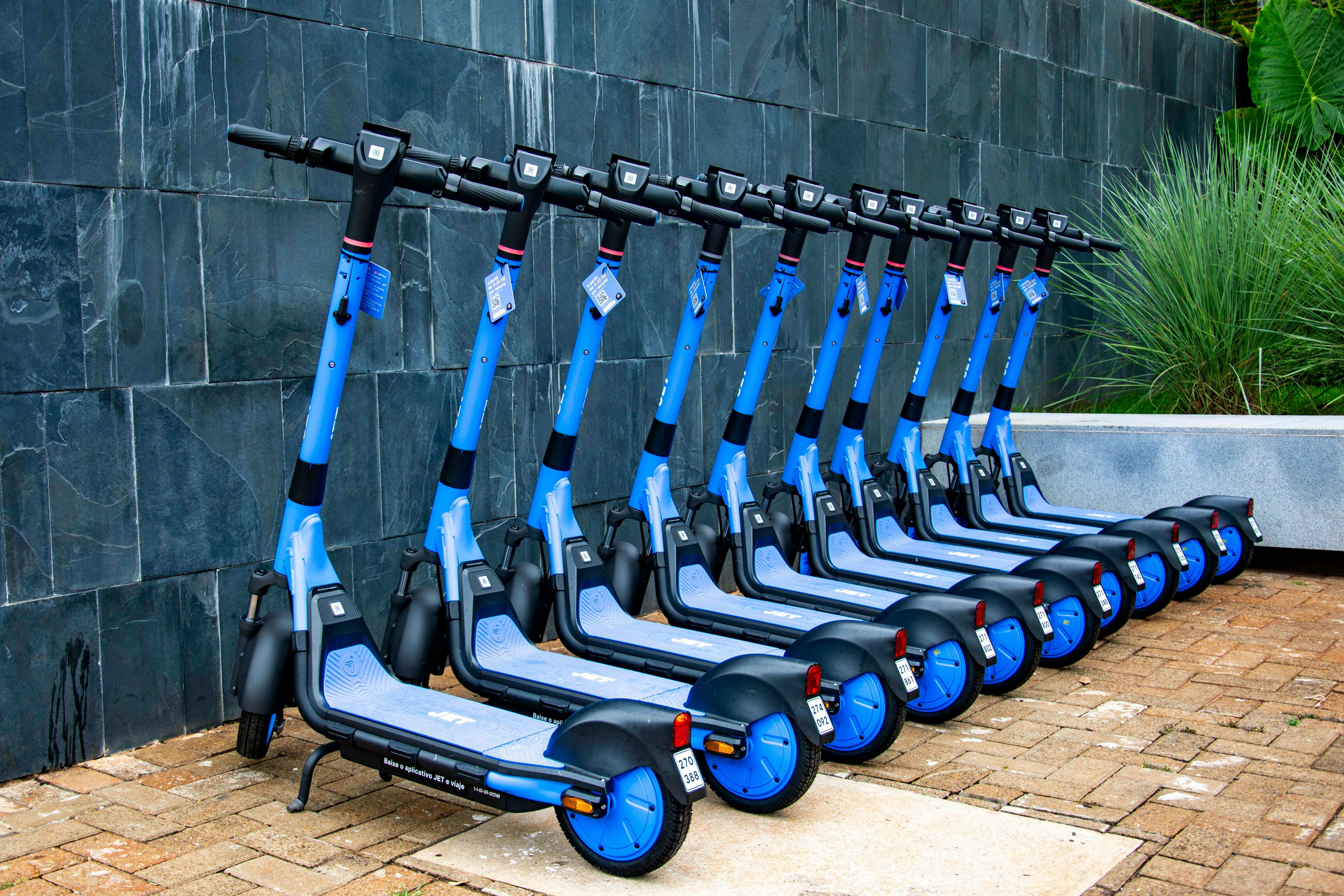
Uniquely, therefore, electrifying active modes usually leads to an increase in carbon intensity. An e-bike, for example, typically generates 18g.CO2 /km – an increase of 10g.CO2/km relative to its human-powered equivalent – while an electric dockless kick scooter can generate as much as 102g.CO2 /km making it even more polluting than a gasoline-powered scooter (90g.CO2 /km) or even an electric car (99g.CO2 /km).
For electric transport, much of the pollution generated relates to embodied carbon obtained in the material acquisition and/or manufacturing stages, especially in relation to batteries and motors. For electric dockless kick scooters, significant carbon is also emitted through the maintenance of fleets as this process often relies on vans being deployed and driven around cities to collect and redistribute the vehicles. Due to operational challenges, these vans are often powered by gasoline or diesel and are therefore carbon intensive.
To see how different urban modes of transport rank based on average transport emissions please refer to the chart by Schunck (2022). The chart not only considers carbon emissions from direct and indirect operations but also takes into account the emissions involved in manufacture, disposal and maintenance of fleet.
The case for electrifying active modes is borne from the additional usage and the modal substitution impacts that can be obtained. Research suggests that an electric bicycle is typically ridden up to twice as far as a conventional pedal cycle which delivers improved utility and capability for the rider.
In many countries in Asia, especially in parts of Southeast Asia where scooters have come to dominate, there has been an historic tendency to trade a non-motorised two-wheeler for a motorised two-wheeler as wealth and incomes grow. This transition leads to an increase in carbon emissions from 8g.CO2 /km to 90g.CO2 /km. However, if this shift occurred to an electric scooter or an electric bicycle instead then emissions would increase to around 21g.CO2 /km or 18g.CO2 /km respectively.
Therefore, while electric active modes generate more carbon emissions per km than their non-motorised counterparts, there may be a net carbon saving where they are used more intensively and used instead of other higher polluting modes.
Electrification may also create opportunities for a broader demographic of people to engage in active travel. This includes older people and more sedentary people for whom engaging in moderate activity may be a barrier to participation in itself.
