


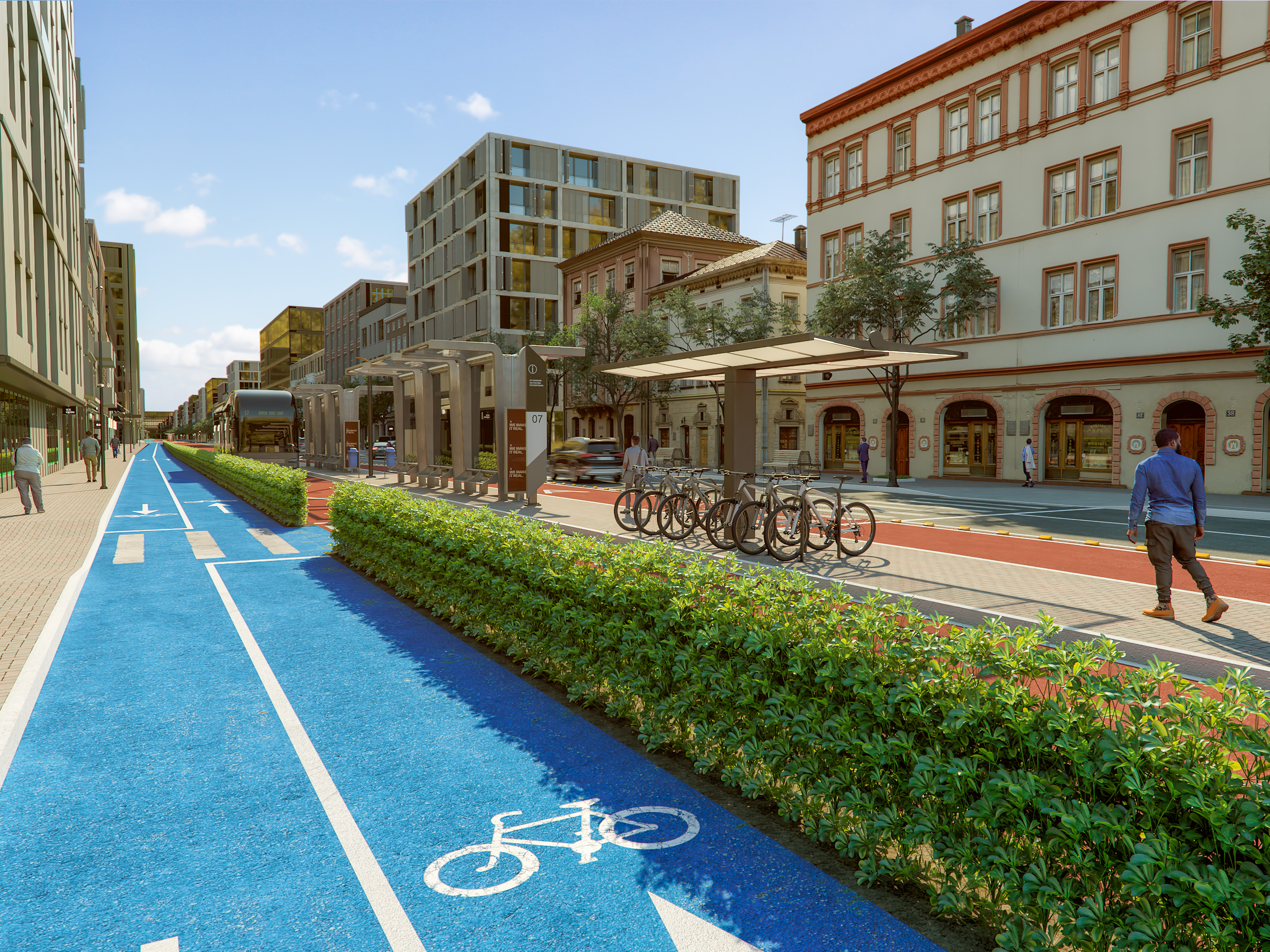
The Green Climate Fund (GCF) supports ADB’s regional E-Mobility Program to scale up e-mobility by addressing the nexus between climate change, transport, energy, poverty, and gender inequality. It will deploy electric buses, upgrade the public transport system, and support non-motorized transport. The program is expected to comprise a total investment of USD 454.40 million, of which USD 169.92 million is contributed by GCF financing. 26% of the GCF investment is for adaptation and 74% for mitigation.
The program will provide loan and grant financing to increase climate resilience of urban transport infrastructure, deploy public transport and non-motorized transport measures to promote sustainable urban development, deploy electric bus fleets including charging infrastructure, bus depots and associated grid connections in eligible countries. Further, these countries can access technical assistance to improve enabling conditions and their readiness for mass deployment of electric buses, applying innovative business models as appropriate. Such models may include, for example, efficient operations of services and private sector participation. Measures to improve the skills of people involved in the field of electric mobility will also be looked into.
The countries covered by the programme include Armenia, Georgia, Indonesia, Kazakhstan, Kyrgyz Republic, Nepal, and Uzbekistan. Mass deployment of electric buses at a regional scale will provide a critical momentum to allow for economies of scale and to create a visible impact to demonstrate low-carbon pathways for future mobility. Adaptation measures to strengthen resilience of the urban transport system will be undertaken in priority countries with higher levels of readiness, to demonstrate innovative solutions that can be replicated in other countries.
The Program acts as a market accelerator that supports a paradigm shift. One of the long-term outcomes of the program is obtaining an electric vehicle (EV) conducive resilient urban ecosystem, which is expected to encourage investors purchasing EVs on a commercial base. The program fosters a structural shift towards low-carbon, resilient sustainable and attractive public transport systems which can revert the declining public transport mode share trend and increase resilience of the urban form. Lessons learnt and cost-effective approaches to reduce the vulnerability of urban transport infrastructure will be extracted based on the program’s adaptation measures, with an aim to replicate successful approaches in ADB’s other transport projects.
The Green Climate Fund (GCF) supports ADB’s regional E-Mobility Program to scale up e-mobility by addressing the nexus between climate change, transport, energy, poverty, and gender inequality. It will deploy electric buses, upgrade the public transport system, and support non-motorized transport. The program is expected to comprise a total investment of USD 454.40 million, of which USD 169.92 million is contributed by GCF financing. 26% of the GCF investment is for adaptation and 74% for mitigation.
The program will provide loan and grant financing to increase climate resilience of urban transport infrastructure, deploy public transport and non-motorized transport measures to promote sustainable urban development, deploy electric bus fleets including charging infrastructure, bus depots and associated grid connections in eligible countries. Further, these countries can access technical assistance to improve enabling conditions and their readiness for mass deployment of electric buses, applying innovative business models as appropriate. Such models may include, for example, efficient operations of services and private sector participation. Measures to improve the skills of people involved in the field of electric mobility will also be looked into.
The countries covered by the programme include Armenia, Georgia, Indonesia, Kazakhstan, Kyrgyz Republic, Nepal, and Uzbekistan. Mass deployment of electric buses at a regional scale will provide a critical momentum to allow for economies of scale and to create a visible impact to demonstrate low-carbon pathways for future mobility. Adaptation measures to strengthen resilience of the urban transport system will be undertaken in priority countries with higher levels of readiness, to demonstrate innovative solutions that can be replicated in other countries.
The program serves as a market accelerator facilitating a paradigm shift. Its goal is to create an urban ecosystem conducive to electric vehicles (EVs), encouraging commercial EV investment. The program promotes a shift to low-carbon, resilient, and appealing public transport systems, reversing declining public transport use and enhancing urban resilience. Lessons learned will inform cost-effective approaches to reduce urban transport infrastructure vulnerability, with successful strategies replicated in ADB’s future transport projects.
