


Register to attend
About the webinar
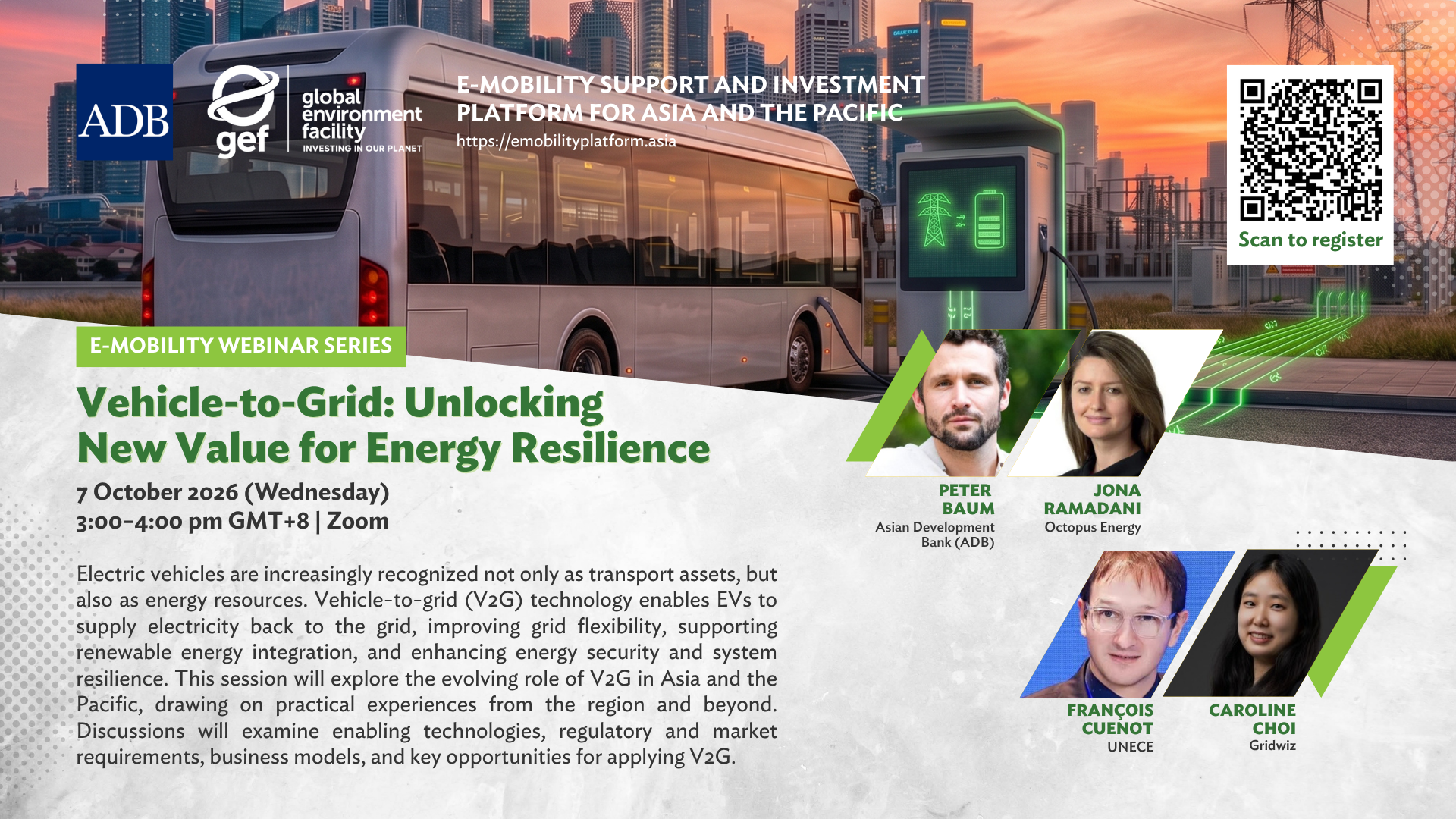
Electric vehicles are increasingly recognized not only as transport assets, but also as energy resources. Vehicle-to-grid (V2G) technology enables electric vehicles to supply electricity back to the grid, improving grid flexibility, supporting renewable energy integration, and enhancing energy security and system resilience.
This webinar will explore V2G's evolving role in the region, drawing on practical experience from Asia and the Pacific and beyond. Discussions will examine enabling technologies, regulatory and market requirements, business models, and the key opportunities for applying V2G.
As electric vehicle fleets expand across Asia and the Pacific, the batteries they carry represent a growing pool of storage capacity. Whether that capacity becomes an asset to the power system depends on decisions being made now about standards, market rules, and investment.
This is the first in a four-part webinar series entitled E-Mobility Webinar Series: Scaling Electric Vehicle Technologies in Asia and the Pacific, organized by the Asian Development Bank's Transport Sector Office. The series examines the latest developments in electric vehicle technologies, the technical and institutional foundations needed for successful adoption, and practical lessons from global and regional leaders. Subsequent sessions cover EV battery technology, sustainable battery end-of-life management, and charging infrastructure.
This webinar forms part of the E-Mobility Support and Investment Platform for Asia and the Pacific, managed by the Asian Development Bank (ADB), and supported by the Global Environment Facility, the United Nations Environment Programme, and other partners as part of the Global Electric Mobility Program.
About the speakers
 | Peter Baum is a Senior Energy Specialist in the Emerging Areas Team at the Asian Development Bank (ADB), where he works on advanced technologies including smart grid applications, electric vehicle grid integration, and floating solar photovoltaics, alongside cross-sectoral energy solutions. Before joining ADB, he carried out power market modeling at Aurora Energy Research, advising investors and lending institutions on renewable energy transactions across Europe, and spent four years at the European Bank for Reconstruction and Development managing energy and infrastructure initiatives in Central Asia, North Africa, and the Middle East. Peter studied at ETH Zurich and holds dual master's degrees in Energy Policy and International Economics from Yale University.
|
 | Jona Ramadani is a Strategic Leader for Vehicle-to-Grid at Octopus Energy.
|
 | François Cuenot works in the Sustainable Transport Division of the United Nations Economic Commission for Europe (UNECE), where he supports the development of vehicle and transport policy across the UNECE region, including work on the electrification of mobility and on measuring the climate impacts of vehicles. He has contributed to UNECE's work on reducing greenhouse gas emissions from transport and on the life-cycle assessment of vehicles. Prior to UNECE, he worked on global transport energy analysis at the International Energy Agency. |
 | Caroline Choi is the Global Strategy Lead of the E-mobility Business Division at Gridwiz. She plays a key role in identifying new e-mobility business opportunities and driving the company's global expansion. She previously served as Strategic Planning Team Lead at Gridwiz, where she developed new clean energy business strategies utilizing distributed energy resources, including e-mobility, demand response, energy storage, and renewable energy. Prior to joining Gridwiz, Ms. Choi was a Senior Consultant in the Climate Change & Sustainability division at KPMG Korea. She holds a master's degree in International Cooperation from Yonsei University. |
