


Register to attend here
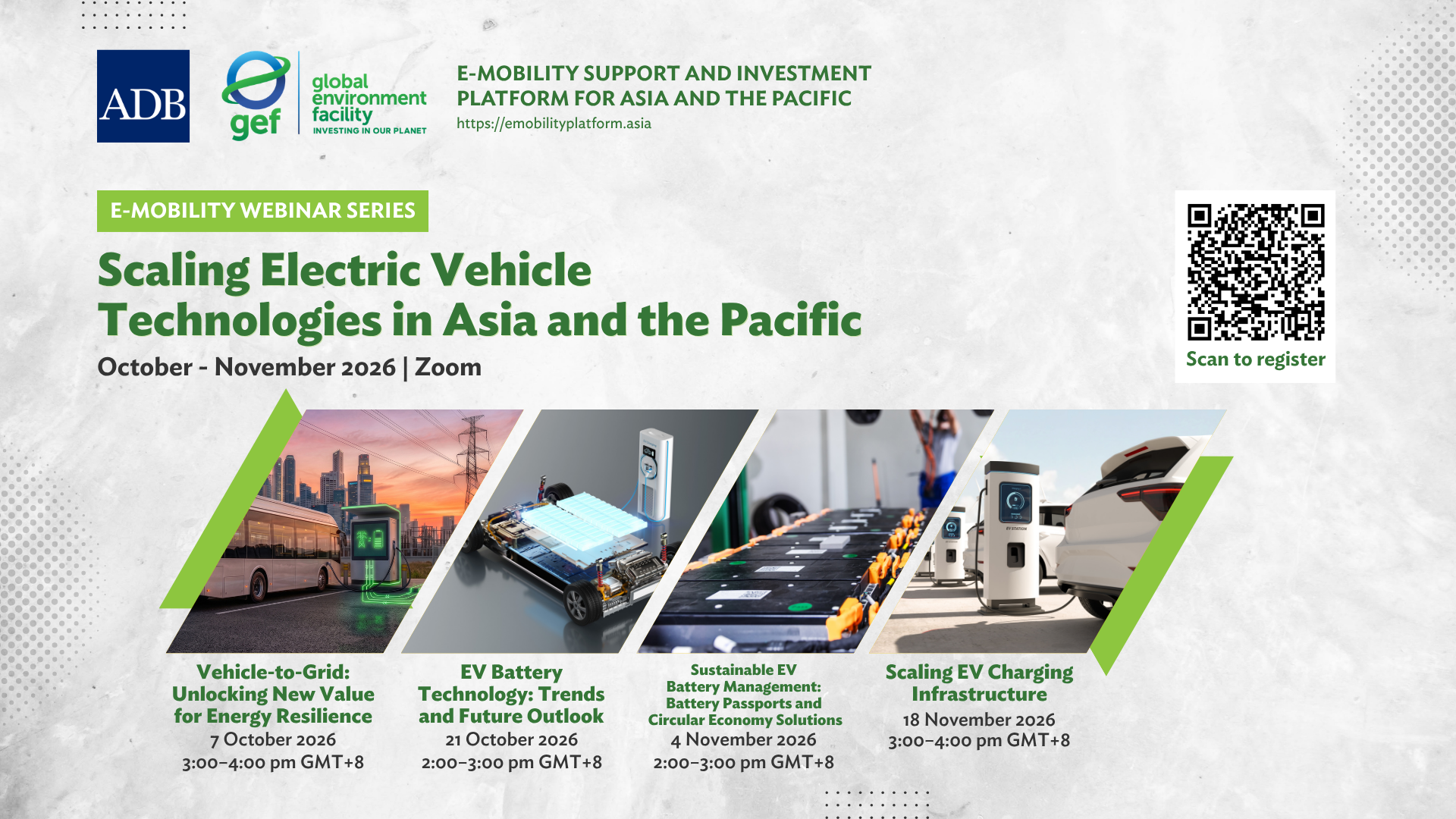
The Asian Development Bank's Transport Sector Office has launched a new four-part webinar series examining what it will take to scale electric vehicle technologies across Asia and the Pacific.
Running from October to November 2026, the E-Mobility Webinar Series: Scaling Electric Vehicle Technologies in Asia and the Pacific brings together industry, government, and development partners to explore the latest developments in electric vehicle (EV) technologies, the technical and institutional foundations needed for successful adoption, and practical lessons from global and regional leaders. The series addresses four interconnected themes: vehicle-to-grid technology, EV battery innovation, sustainable battery end-of-life management, and charging infrastructure deployment.
The webinar series is organized by the Asian Development Bank's Transport Sector Office under the E-Mobility Support and Investment Platform for Asia and the Pacific, supported by the Global Environment Facility-funded Global Project to Support Countries with the Shift to Electric Mobility, which is managed by the United Nations Environment Programme (UNEP).
Session 1: Vehicle-to-Grid — Unlocking New Value for Energy Resilience
📅 Wednesday, 7 October 2026 | 3:00–4:00 PM (GMT+8) | Zoom
Electric vehicles are increasingly recognized not only as transport assets, but also as energy resources. The opening session will explore vehicle-to-grid (V2G) technology, which enables electric vehicles to supply electricity back to the grid—improving grid flexibility, supporting renewable energy integration, and enhancing energy security and system resilience. Discussions will examine the enabling technologies, regulatory and market requirements, and business models that V2G depends on, drawing on practical experience from within the region and beyond.
Session 2: EV Battery Technology — Trends and Future Outlook
📅 Wednesday, 21 October 2026 | 2:00–3:00 PM (GMT+8) | Zoom
Battery technologies are the key drivers of electric mobility advancement. Innovations in battery technology are expected not only to reduce costs and improve vehicle performance, but also to enhance safety and expand the range of applications for electric vehicles. This session will examine emerging technologies—including sodium-ion and solid-state batteries, ultra-fast charging, and new battery chemistries—that have the potential to address key barriers to EV adoption while reducing dependence on critical minerals. Discussions will highlight commercial readiness, expected cost trajectories, and what these developments mean for emerging markets across Asia and the Pacific.
Session 3: Sustainable EV Battery Management — Battery Passports and Circular Economy Solutions
📅 Wednesday, 4 November 2026 | 2:00–3:00 PM (GMT+8) | Zoom
The rapid growth of electric mobility in Asia and the Pacific is increasing the need to sustainably manage EV batteries at the end of their first life. Sound end-of-life management can minimize environmental and safety risks while creating opportunities for battery reuse, second-life applications, recycling, and the recovery of valuable materials for reintegration into battery value chains. This session will examine emerging approaches to sustainable battery end-of-life management, including battery passports, and explore how policymakers, industry, and development partners can work together to strengthen circular battery value chains ahead of growing volumes of end-of-life batteries.
Session 4: Scaling EV Charging Infrastructure
📅 Wednesday, 18 November 2026 | 3:00–4:00 PM (GMT+8) | Zoom
The transition to electric mobility depends on the timely deployment of reliable, accessible, and financially sustainable charging infrastructure. While private sector investment is expected to play a leading role, experience shows that charging markets often face early-stage challenges related to low utilization, high capital costs, grid connection, and market fragmentation. The closing session will examine how charging markets are evolving, what can be learned from deployment experience to date, and how policymakers, industry, and development partners can work together to accelerate investment and scale up across the region.
Register to attend
