


About the webinar
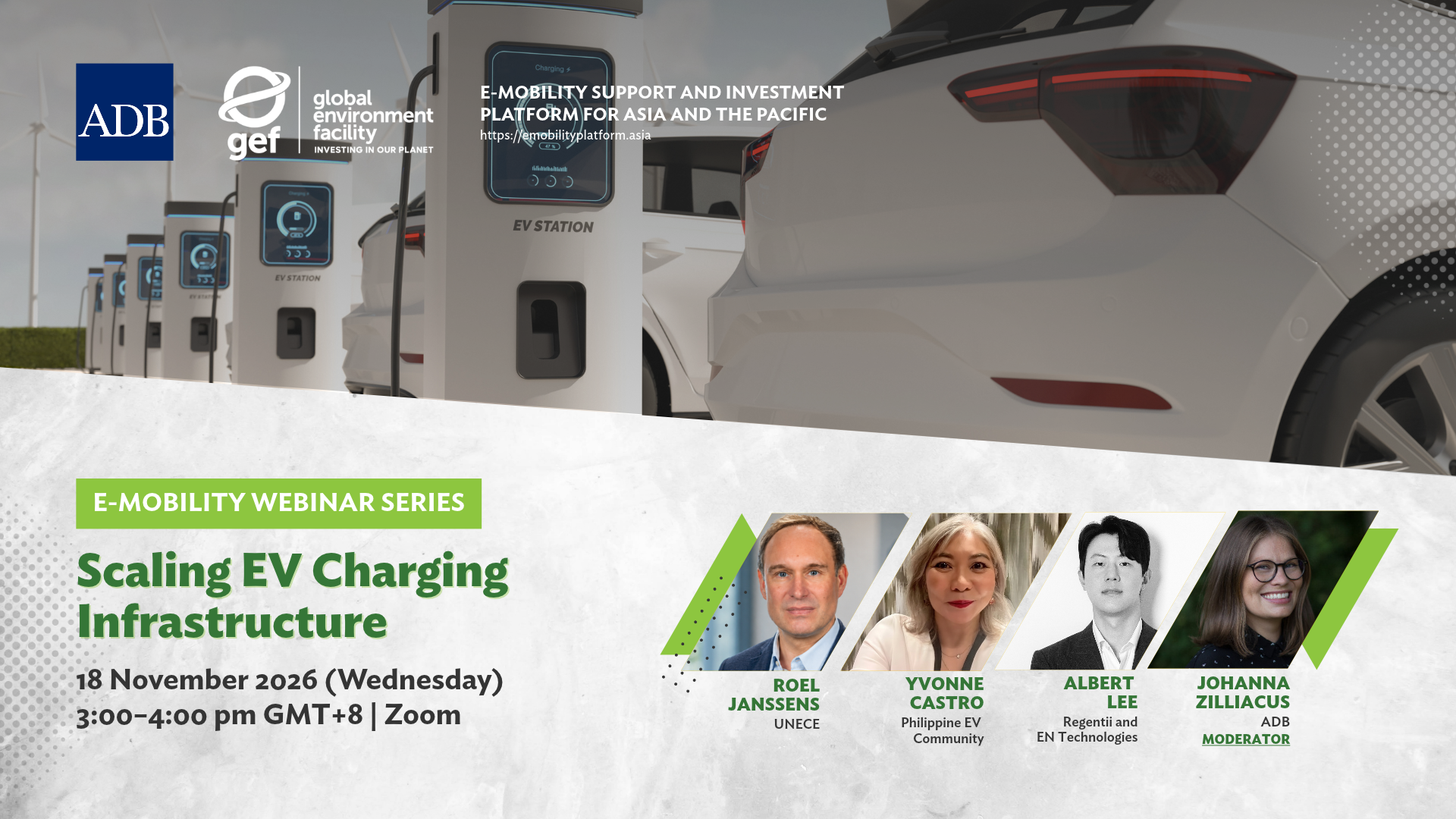
The transition to electric mobility in Asia and the Pacific depends on the timely deployment of reliable, accessible, and financially sustainable charging infrastructure. While the private sector is expected to lead investment, charging markets often face early-stage challenges, including low utilization, high capital costs, grid connection constraints, and market fragmentation. This session will examine how charging markets are evolving, drawing on lessons from the evolution of charging infrastructure in Europe and on country experience from the Philippines and Viet Nam, including a charging network built for two-wheelers. It will also explore how policymakers, industry, and development partners can work together to accelerate investment and scale up charging infrastructure across the region.
This is the third in a four-part webinar series entitled E-Mobility Webinar Series: Scaling Electric Vehicle Technologies in Asia and the Pacific, organized by the Asian Development Bank's Transport Sector Cluster. The series examines the latest developments in electric vehicle technologies, the technical and institutional foundations needed for successful adoption, and practical lessons from global and regional leaders. Previous sessions explored vehicle-to-grid technology, battery technology trends, and sustainable battery end-of-life management.
This webinar forms part of the E-Mobility Support and Investment Platform for Asia and the Pacific, managed by the Asian Development Bank (ADB), and supported by the Global Environment Facility, the United Nations Environment Programme, and other partners as part of the Global Electric Mobility Program.
About the speakers
 | Roel Janssens is an Economic Affairs Officer in the Sustainable Transport Division of the United Nations Economic Commission for Europe (UNECE), where he serves as Secretary to the Working Party on Transport Trends and Economics (WP.5). In this role, he leads UNECE’s inland transport work on emerging trends shaping the sector, including climate change mitigation and adaptation, e-mobility, and the resilience of transport systems. He coordinated UNECE’s study Electrification of Mobility: Lessons Learnt from the ECE Region (2025) and, with UNECE colleagues, prepared the UNECE E-Mobility Compendium (2025). His wider work covers multimodal transport, corridor management, and border facilitation, with a focus on infrastructure alignment, interoperability, digitalization, resilient supply chains, and regional economic integration between the pan-European region and neighboring regions. |
 | Yvonne Castro has worked on the Philippines’ transition to electric mobility since 2007, where policy, industry, and sustainable transport meet. As the first Project Director of the Institute for Climate and Sustainable Cities, she led projects that introduced electric jeepneys in Makati and Puerto Princesa City, helping lay the foundation for the country’s electric vehicle industry. She later became the founding Executive Director of the Electric Vehicle Association of the Philippines. As Vice President and acting Chief Executive Officer of Bemac Electric Transportation Philippines, she built the country’s first electric vehicle manufacturing operations, which supplied the Department of Energy’s ADB-funded electric tricycle program in 2014. She also helped draft the Implementing Rules and Regulations of the Electric Vehicle Industry Development Act and the first Comprehensive Roadmap for the Electric Vehicle Industry, the anchor policies of the Philippine electric vehicle industry. She serves as a Board Member of the Philippine EV Community. |
 | Albert Lee is the Founder and Chief Executive Officer of Regentii, a technology and platform holding company, and Chief Executive Officer of EN Technologies. Through Regentii, he is leading the development of VIA, an electric two-wheeler charging platform in Viet Nam and across Southeast Asia. VIA brings charging to everyday destinations through partnerships with local businesses, combining connected hardware with digital payments, settlement, and operating tools for site partners. At EN Technologies, he leads a power electronics and energy technology business with capabilities in plasma power supplies, electric vehicle charging equipment, and energy storage systems. There he oversees corporate strategy, product commercialization, strategic partnerships, and international business development. Earlier in his career, he worked at Mandelbaum Barrett P.C. after passing the New York and New Jersey bar examinations. He holds an undergraduate degree from The Pennsylvania State University and a Juris Doctor from Rutgers Law School. |
About the moderator
 | Johanna Zilliacus is a development professional in the fields of climate finance, climate policy and low carbon development. She works as a consultant for ADB’s Transport Sector Group, supporting the coordination of the E-Mobility Support and Investment Platform, as well as other transport decarbonization initiatives. Beyond ADB, she has worked and consulted for a vast range of organizations, including UNDP, Green Climate Fund and Nordic Development Fund. She holds a M.Sc. in Economics and Business Administration, and is currently studying a second master’s degree in social inclusion, with a specialization in gender studies.
|
